Legalities in Spain
There are various legalities in Spain that need to be completed when you first come to live here. The important ones are getting your TIE or NIE in Barcelona, your social security number and registering at the local town hall, which is called empadronamiento.

NIE (Número de Identificación de Extranjero)
If you’re from an EU member state (or Switzerland) you don’t need a work visa in order to work in Spain, but you do need a número de identificación de extranjero (NIE). You need to go to the local Oficina de Extranjeros (Foreigner’s Office) to make your application. This is often a police station.
You can apply for a non-resident NIE from your own country at the Spanish Consulate or Embassy as well. However, if you intend to become a resident in Spain, you must apply for your NIE in Spain.
In Spain you should make an appointment either at the Oficina de Extranjeros or the police station – Comisaría Policía. There is often a wait of 4-8 weeks for an appointment, so apply as soon as possible.
NIE in Barcelona – How to apply

There are two types of NIE – non-resident and resident. Anyone living in Spain for more than three months should apply for the resident NIE.
Staying in Barcelona for 3 months or less
As a non-resident in Spain and staying here for less than three months, this is the type of NIE to apply for. It’s easier to obtain than the resident’s NIE. It can be upgraded at any stage if you become resident, and the number itself does not change. On the application form you must state your economic, professional or social reason for applying.
You don’t need to apply in person for this NIE. You can give authority to another person (usually an immigration lawyer or gestor) to act on your behalf. The NIE when issued is an A4 piece of paper.
Staying in Barcelona for more than 3 months
If you are an EU, EEA or Swiss citizen who is settling in Spain or planning to stay for more than three months, then you need to apply for a resident NIE. This application is more complicated as you have to prove one of the following:
- that you have employment or that you are self-employed
- that you have sufficient funds to support yourself and have private health insurance
- that you are a student (again with sufficient funds and private health insurance) in either a private or public school
- that you are here to join a family member under the conditions of the European Economic Area
This NIE is issued as a small credit card-sized piece of paper. DO NOT laminate it as this makes it invalid.
For EU nationals the Foreigner’s Office in Barcelona city is at Rambla de Guipúscoa 74
______
NIE application process
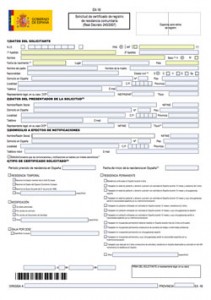
The application process is similar for both types of NIE, but you need to fill out different forms depending on which NIE you’re applying for. Form EX-15 for the non-resident NIE and form EX-18 for the resident NIE.
Firstly, go online and book an appointment. Below is the link to the website where you can make an appointment. The waiting period can be several weeks and the allocation is filled quickly each day, so try first thing in the morning and check often as sometimes appointments can open up.
How to make an appointment for your NIE
1. Here is the link to request an appointment online:
https://sede.administracionespublicas.gob.es/pagina/index/directorio/icpplus
2. These links tend to change, so if the link above has changed, follow these instructions. From the home page (https://sede.administracionespublicas.gob.es/) here is how to navigate to the correct page:
Choose: Extranjería > Cita Previa de Extranjería > Acceder al Procedimiento > then choose your province (Barcelona) > then choose the office for the area where you live (for Barcelona this is Rambla de Guipúscoa 74) > then choose POLICIA-CERTIFICADOS Y ASIGNACION NIE.
Then follow the instructions to book an available appointment.
To apply for your NIE will need:
- The receipt of your appointment
- Completed and signed application form
- Your passport and a photocopy
- Documentation to support your application:
- For a non-resident NIE justification can be a property or car purchase or having to pay tax, for example.
- For a resident NIE: proof of employment or business set up; for students – proof of enrollment and medical insurance; or proof of funds to support yourself and private medical insurance.
- Proof of payment of the admin fee. Complete form 790 online then you can make the payment at any bank.
It’s also possible that you’ll be asked for passport sized photos. This depends on the region where you’re applying, so double check first what the local requirements are. It’s advisable to photocopy everything, at least once.
Sometimes your NIE is issued the same day, and sometimes you need to go back to collect it.
To summarise:
- Form EX-15 for a non-resident NIE application
- Form EX-18 for EU citizens registering as residents in Spain
- Form EX-17 for a TIE – non-EU nationals obtaining residency in Spain (see below for details on the TIE application)
Why you need an NIE number?
- It’s required by law
- To open a resident bank account (you can open a non-resident’s bank account with your passport)
- To work in Spain
- To buy and sell property
- To by a car
- To set up a business
- To get a loan or a mortgage
- To apply for a driver’s licence
- For tax payments
- To receive unemployment benefit
- To open some utility accounts depending on the company, such as gas, water, electricity; and for internet and mobile phone contracts
- To register for Bicing and other transport sharing services.
Offices where NIEs are issued
The police office in Barcelona only deals with applications if you live within Barcelona city. If you live outside Barcelona city check below to find your local foreigners’ office.
Barcelona city – Rambla de Guipúscoa 74
Badalona – Av. Dels Vent,s 9-13
Castelldefels – Pl. Esperanto, 4C
Cerdanuyola Del Valles – Calle Verge de Les Feixes, 4
Cornella de Llobregat (includes Esplugues) – Av. Sant Ildefons, s/n
Granollers – Calle Isabel de Villena, 30
L’Hospitalet de Llobregat – Rambla Just Oliveras, 43
Igualada – Calle Prat de la Riba, 13
Manresa – Calle Soler i March, 5
Mataro – Av Gatassa, 15
Montcada i Reixac – Calle Major, 38
Prat de Llobregat – Calle Centre, 4
Ripollet – Calle Tamarit, 78
Rubi – Calle Terrassa, 16-18
Sabadell – Calle Batllevell, 115
Sant Adria de Besos – Av. Joan XXIII, 2
Sant Boi de Llobregat – Parc Marianao, s/n
Sant Cugat del Valles – Calle Valles, 1-3
Sant Feliu de Llobregat – Calle Carreretes, 9-11
Santa Coloma de Gramenet – Calle Irlanda, 67
Terrassa – Calle Baldrich, 1
Vic – Calle Bisbe Morgades, 4
Viladecans – Jaime Abril, 2
Vilanova i La Geltru (includes Sitges) – Calle Vapor, 19 Bajo
TIE
The TIE (Tarjeta de Identidad de Extranjero) is the official residence card for non-EU nationals. It proves your legal residency and includes your NIE number and biometric data. You must apply for the TIE within 30 days of arriving in Spain.
Who needs a TIE?
Non-EU nationals staying in Spain for more than 90 days, students, digital nomads, retirees, workers with residence permits, British citizens who have moved to Spain post-Brexit and family members of EU citizens who have been granted residency.
As a British national, if you have been legally living in Spain since before 1 January 2021, you and your family have certain rights under the Withdrawal Agreement. Here’s a link to the UK Government website page about rights under the Withdrawal Agreement.
How to apply for a TIE in Spain
You’ll need the following documents:
- A residence approval or visa
- Passport – original and a photocopy
- A completed EX-17 form
- Payment receipt for the application – around €16
- Three recent passport-sized photos
- Your registration at the local town hall – empadronamiento
The application procedure:
- Pay the fee – complete the Modelo 790 online and then pay the fee at any bank. Keep the receipt as you’ll need to show it.
- Book an appointment – go to the Sede Electrónica (sede.administracionespublicas.gob.es) and search for Policía – Toma de Huellas in Barcelona or the region where you’re living.
- Go to your appointment with all your documents.
- Collect your TIE. If your application is approved your card will be ready in around 20–30 days.
Use a Gestor to help with your NIE or TIE application
It’s not common that administrative workers at these offices speak English, so you need to have some knowledge of Spanish. Try to take a friend or someone with you who speaks Spanish and can translate for you – or use a gestor.
Gestors are administrators, and for a reasonable fee they will help with all your legalities in Spain, including the NIE application process. It will save you an awful lot of time and frustration. They will organise the necessary paperwork, wait in the queues for you and help you to obtain your NIE, TIE or act for you on any number of administrative issues.
Even if you do speak Spanish it can be worth hiring a gestor, simply because they know the system. Many Spanish people do so.
I can recommend a gestor who specialises in helping people get their NIE and TIE, as well as helping with other issues such as social security numbers, traffic office administration, empadronamiento. She offers a fast and efficient service and very competitive rates.
- Please send an email to: [email protected] for the contact details of my recommended gestors.
- You can also search the directory of gestors in Spain, by region and by speciality: gestorias.es/barcelona
______
Residency permit (Tarjeta de Residencia)
The Tarjeta de Residencia is now an NIE – a resident’s NIE, or a TIE for non-EU nationals (see above).
How to apply for a Social Security number
A social security number (NUSS — Número de Afiliación a la Seguridad Social) is required in Spain for any type of work activity – employment or self-employment, as well as to register with a doctor.
You need an NIE number to apply for a social security number, however, you can apply without one and provide your NIE later. It’s advisable though to get your NIE first, because otherwise you have to go through almost the same process to add your NIE at a later date.
As a non-EU citizen you can apply using your passport, but you have to support the application with a residence and work permit.
Applications can be made online at the social security website: sede.seg-social.gob.es, or in person at a social security office.
If you have a digital certificate the online application process is slightly easier, but you can also select to apply online without a digital certificate, as you will be prompted to send an SMS, and in reply you’ll receive a security code to continue your online application.
Follow the instructions to complete the online form and supply your contact details.
To summarise, in order to apply for a social security number you need:
- Número Identificatión de Extranjero (NIE) or some form of national identity
- Your passport (or certificate of residency)
- Form TA1
To apply in person you need make an appointment at one of the local Social Security offices (Tesorería de la Seguridad Social).
______
Empadronamiento or registering at your local town hall
This is obligatory for anyone staying in Spain for more than a short stay. Each barrio (neighbourhood) has a town hall (ayuntamiento) and you need to register there.

If you have a rental contract for where you are living this is a very easy process. Simply take your passport and rental contract to the local ayuntamiento and you will be registered.
You will be given a piece of paper certifying this, and it’s a good idea to ask for a few copies, as you will need to show or give your empadronamiento certificate for many other administration processes and it’s good to have extra copies.
You may have problems registering at your local ayuntamiento if you don’t have a rental contract. The Ayuntamiento will accept a utility bill in your name such as a gas or electricity bill, and you could also try a mobile phone bill. Basically you need proof of identity and proof that you’re living at your address. The main thing that they seem to be interested in, is that all the documents are originals, they will not accept photocopies of anything.
If your name is not on the rental contract – you are sharing a flat with another person, for example, who holds the contract – you will need to ask the person who has the contract to complete a form called Autorización de Empadronamiento, which you must first obtain from the ayuntamiento.
This form requires that the person who is registered at your address (they must be registered at the Ayuntamiento at the same address) verifies that you are also living at that address.
The person needs to complete and sign the form, and also give you a photocopy of either their DNI or passport (in this case a photocopy will suffice).
Take this documentation back to the ayuntamiento together with your passport and you will be registered.
If you are sharing with people who are not registered at that address, then you have a problem.
You have to show the original copy of the rental agreement to the ayuntamiento (so you have to request this from whoever holds it), together with the completed Autorización de Empadronamiento form, plus a photocopy of the person’s DNI, and, it goes without saying, your passport.
ITP (Impuesto sobre Transmisiones Patrimoniales)
You can read the full article here on how to pay your ITP. ITP is a tax that is charged when you rent a property in Spain for the short to medium term. The charge differs between autonomous regions; in Catalonia it’s 0.5% of the total rent. For long term rentals it’s 0%, but should still be filed!
Use an administrator to help with your legalities in Spain
Use a local administrator (gestor) who knows the system. It will save you time and stress.
I can recommend an English-speaking gestor. Please send an email to: [email protected] for the contact details.
British Embassy Website
The British Embassy website offers good advice in English on moving to Spain and on what you should do before you make the move:
British Embassy website.
UK Consulate, Barcelona
Av. Diagonal 477, Esq. Eixample. Tel. 93 366 62 00.